

Hot Press News
- Accor Signs Novotel in Andhra Pradesh's Emerging Coastal Destination
- InboundSync Strengthens CRM Migration Between HubSpot and Salesforce
- KWT Spider 2.0 Adds Instant URL Audits Combining Technical SEO and AI Search Scoring
- Galderma introduces Sculptra® in India, ushering in a new era of regenerative aesthetics
- Creative Diagnostics Launches Respiratory Syncytial Virus Animal Model Services for Antiviral and Vaccine Discovery
- CD Bioparticles Launches Advanced Microneedle Device Customization Services to Accelerate Transdermal Drug Delivery Innovation
- NABARD signs MoU with MAHAPREIT to Accelerate Green Infrastructure in Rural India
- Softaken Upgrades OLM to PST Converter for Enterprise-Grade Migration
- Shriram Farm Solutions inks MoU with ICAR-IIVR to access breeder seeds for five vegetable crops
- Dan Home Painting Services Introduces Premium Bathroom Renovation Melbourne
- NCQC Laboratory LLP Successfully Completes International On-Site Calibration Project at Singapore-Based ERRL Pte. Ltd.
- Picklebay Named Title Sponsor for Team India Kids (U-14) Contingent at Pickleball World Cup 2026
- AAFT Becomes First Media Institutions in India to Offer Comprehensive OB Van Training
- Zarveek Elevates Men's Jewelry at IIJS with Architectural Black Gold Designs
- MAHE, Manipal Foundation and KITES Senior Care Launch Industry-Academia Partnership to Build India's Future Geriatric Care Workforce
 Mail to a Friend Mail to a Friend |
|
 Rate Rate |
 |
MIT-WPU Researchers Develop Solar Thermal Battery That Enables Hot Water Availability After Sunset
2026-07-27 08:17:06
Education
373
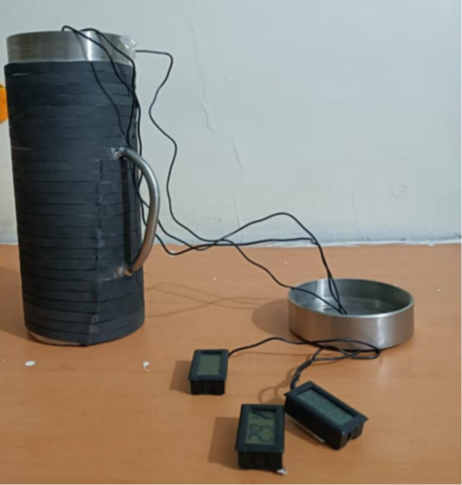
Mumbai/Pune: Researchers at MIT World Peace University (MIT-WPU) have developed a solar thermal energy storage system that enables hot water availability even after sunset by storing solar heat in a phase change material (PCM)-based thermal battery. The technology addresses one of the biggest challenges associated with solar energy—its intermittent availability—and has the potential to reduce dependence on electricity and fossil fuels for water heating applications.
Developed by Dr. Anita Nene and Dr. Rohit Ghadge from the Department of Mechanical Engineering, MIT-WPU, the system combines a Scheffler solar concentrator with a thermal storage capsule containing paraffin wax, a phase change material capable of storing and releasing large amounts of heat.Unlike conventional energy storage systems that rely on electrochemical batteries, the proposed solution stores energy directly as heat. The system incorporates a detachable PCM tube, a water-jacket heat transfer mechanism, and polyurethane insulation to maximize heat retention and energy utilization.
According to the researchers, the technology achieved complete thermal charging in
approximately 18 minutes and complete discharge in approximately 32 minutes during laboratory-scale testing. The system continued supplying hot water after solar input was removed, demonstrating its ability to provide thermal energy beyond daylight hours.
The prototype stores approximately 1.5 to 2 kWh of thermal energy and can maintain water temperatures between 50°C and 60°C for up to 14 hours after charging. Compared to conventional electric water heaters.
“One of the major limitations of solar energy is that it is available only when the sun is shining. Our objective was to develop a simple, cost-effective, and sustainable thermal storage solution that can store solar energy and make it available whenever required,” said Dr. Anita Nene.
“Thermal energy accounts for a substantial share of overall energy consumption. Technologies that enable efficient storage of solar heat can help reduce dependence on conventional fuels, improve energy security, and support the transition towards cleaner and more sustainable energy systems,” said Dr. Rohit Ghadge.
The researchers conducted Computational Fluid Dynamics (CFD) simulations alongside laboratory-scale validation to evaluate system performance. The technology is currently at Technology Readiness Level (TRL) 7 and is being prepared for pilot deployments in real-world environments.
Potential applications include residential water heating systems, hotels, hospitals, hostels, educational institutions, industrial process heating facilities, community kitchens, agricultural operations, and off-grid rural communities.
An Indian patent application titled “Solar Energy Storage Capsule Using Phase Change
Material” has been filed under Application No. 202521118546. The researchers are currently exploring collaborations with industry partners for pilot deployment and commercialization.
“The next phase of development will focus on field trials, performance optimization, and scale-up for commercial deployment,” said Dr Anita Nene.
ABOUT MIT-WPU
MIT World Peace University (MIT-WPU), Pune, is a prestigious world-class institution of higher education in India, embodying a distinguished legacy of 40+ years and committed to nurturing academic excellence. With an expansive global alumni network exceeding 1,00,000 accomplished professionals, MIT-WPU consistently demonstrates exceptional educational achievements. The university remains at the forefront of academic innovation, offering a comprehensive study of over 150 undergraduate and postgraduate programmes, each meticulously crafted to blend theoretical foundations with practical application. Embracing an educational philosophy centred on experiential learning, MIT-WPU empowers students to transition knowledge into tangible skills for the real world seamlessly. This ethos is further reinforced through immersive internships and invaluable mentorship opportunities, catalysing profound personal and professional development.
We envision a future powered by education, innovation, and culture, one that is sustainable, inclusive, and fosters progressive societal transformation ("Powering the Future"). To achieve this, we cultivate a culture of excellence with three pillars: fostering exemplary leadership, prioritising empathy and improving the present for all, and emphasising interdisciplinary collaboration in our educational approach. Ultimately, we believe that true global peace and harmony can be reached through the concordant integration of Science and Spirituality.
Company :-Dentsu
User :- Nitin Jaitapkar
Email :-Nitin.Jaitapkar@dentsu.com


To ensure stability and reachability of your applications at all times, remote DDoS protection can keep your hosting services online
Get your Explainer Video at 100 dollars only Today.