

Hot Press News
- Spyne survey reveals 90% of used-car dealers surveyed do not use a CRM to store leads
- Shankar Fenestrations and Glasses Expands Its Project Portfolio with CRC The Flagship
- Dr. Sandeep Marwah Honoured with Prestigious MSME Award in New Delhi
- John Crane strengthens reliability at phosphate mining and processing operations
- Ganesh Spices Launches ‘Pure Masala. Sure Swaad.’ Campaign Featuring Actors Parambrata Chattopadhyay and Raima Sen
- Punjab National Bank Observes Vigilance Awareness Week
- Palestinian Ambassador Presented with Festival Memento by Dr. L. Murugan at 19th Global Film Festival Noida
- Prime Video Unveils Trailer of 'Vibe' at PVR Lido
- Hitek Computer School Receives 2027 Consumer Choice Award for Computer Training
- Kenstar Brings Warmth, Love and Lasting Comfort with Rajkummar Rao and Patralekha in its New Water Heater Campaign
- Popeyes® India Unveils Limited-Edition Halloween Menu Featuring Its Viral Black Haunted Sauce
- DCM Shriram Reports 22% Revenue Growth in Q2 FY27 at INR 3,977 Crore
- ReadyBid Targets Data Center Expansion Travel with Smarter Hotel Sourcing
- Dalmia Bharat Limited reported Steady Performance in a Challenging Environment
- FreeWebsite247 Launches Free Websites for U.S. Local Businesses
 Mail to a Friend |
|
 Rate |
 |
Spyne survey reveals 90% of used-car dealers surveyed do not use a CRM to store leads
2026-10-27 08:19:19
Automotive
69
27 October 2026: Spyne, an AI-native automotive retail technology company built in India and backed by Vertex Ventures, Accel, Storm Ventures and Alteria Capital, today released findings from its survey of used-car dealers across the country. Spyne currently works with more than 3,600 dealerships globally.
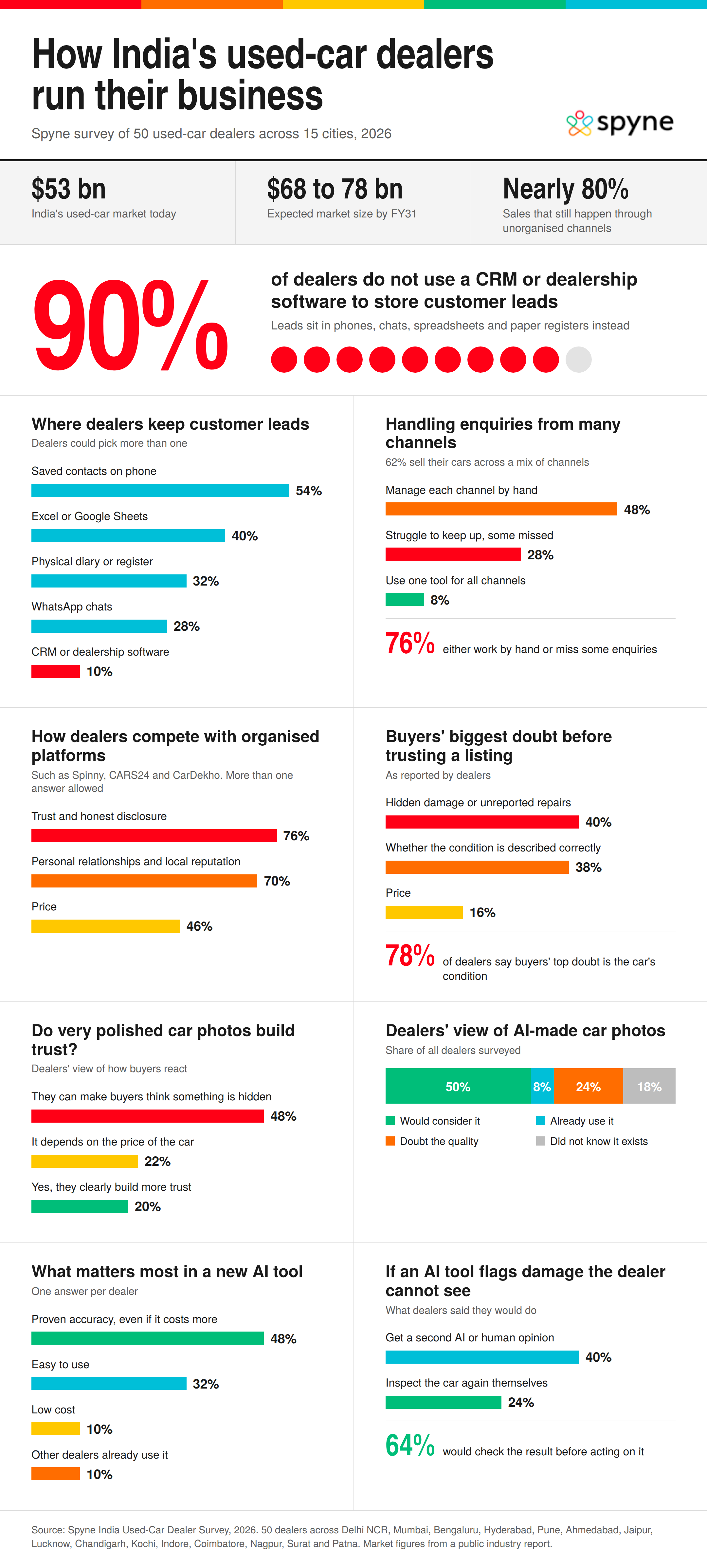
The company has scaled its automotive retail technology across global markets, while India itself represents a significant opportunity. According to a recent public industry report, India's used-car market is currently valued at around $53 billion and is projected to reach $68–78 billion by FY31. The market is expected to see 9–10 million retail transactions annually by then, while nearly 80% of transactions continue to take place through unorganised channels.
Despite the size and growth of the market, many independent used-car dealers in India continue to manage large parts of their business through phone calls, WhatsApp, spreadsheets and physical records. Technology adoption across lead management, customer follow-ups and other dealership processes also remains limited.
This gap between the size of the market and the way many dealerships currently operate prompted Spyne to look more closely at the Indian used-car dealer ecosystem. That prompted Spyne to survey dealers across major Indian cities on how they market inventory, manage customer enquiries, build buyer trust, view and adopt newer technologies such as Artificial Intelligence.
"India is a large used-car market, but the way dealers operate here is very different from some of the markets we work with globally. A lot of the business still runs through calls, WhatsApp, spreadsheets and personal relationships. We wanted to understand how the Indian dealer works today, where the gaps are, and what technology needs to be addressed so that it becomes useful in their day-to-day business." — Sanjay Varnwal, Co-founder and CEO, Spyne
The findings show that the gap is most visible in how dealers manage customer enquiries. 90% of surveyed dealers do not use a CRM or dealership software to store leads and enquiries. Instead, 54% save leads as contacts on their phones, 40% use Excel or Google Sheets, 32% use physical diaries or registers, and 28% keep enquiries in WhatsApp chats.
This is happening even as dealers use more channels to reach customers. 62% market their inventory across a mix of channels rather than depending on one primary platform. When enquiries start coming from these different sources, 48% said they manage each channel manually and separately, while 28% said they struggle to keep up leading to few missed enquiries.
Trust remains another important part of the business. 76% of dealers said trust and honest disclosure help them compete with organised used-car platforms, while 70% rely on personal relationships and local reputation. Price was cited by 46%.
Buyer questions reflect the same concern. 78% of dealers said the most common doubts raised by buyers relate to the condition of the vehicle, either related to hidden damages or doubts pertaining to the accuracy of the condition shown in the listing.
Trust continues to matter when dealers compete with organised platforms
The survey asked independent dealers how they compete with organised platforms such as Spinny, CARS24 and CarDekho.
The responses show that independent dealers continue to depend heavily on the relationship they have with buyers. 76% cited trust and honest disclosure around areas such as service history and vehicle condition, while 70% pointed to personal relationships and local reputation.
This also shows up in the questions buyers ask.
40% of dealers said hidden damage or unreported repairs are the most common concern before a buyer trusts a used-car listing. Another 38% said buyers question whether the condition of the vehicle has been described accurately. Price was the main concern for 16%.
For dealers, this puts more importance on how accurately a car is represented online. A customer may first see the vehicle on a marketplace, Instagram or WhatsApp, but that listing also sets an expectation about what they will see when they visit the dealership.
"Used cars are a trust business. The customer is buying one specific car with its own history and condition. A good photograph can bring the customer in, but the car still has to match what they saw online. If it looks very different when they reach the dealership, the conversation starts with doubt. Dealers understand this very well because their reputation is attached to every car they sell." — Sanjay Varnwal, Co-founder and CEO, Spyne
More channels are making lead management harder
The survey found that 62% of dealers use a mix of channels to market inventory, with no single channel accounting for most of their activity.
That gives dealers more ways to reach buyers, but the information coming back from those channels is often stored separately.
When asked how they handle enquiries from different channels, 48% said they manage each channel manually and separately. Another 28% said they struggle to keep up and some enquiries get missed. Only 8% said they use a CRM or another tool that brings enquiries from different channels together.
The gap is also visible in the broader use of software. 46% said they do not use any tool or software in their business and continue to work through phones, WhatsApp, Excel or paper. Among dealers who do use software, photography and listing tools are more common than tools for managing enquiries and follow-ups.
This suggests that dealers have adopted digital channels faster than they have changed the processes used to manage the business behind those channels.
Polished vehicle images can also create questions
How a used car is presented online is another area where dealers see trust differently.
48% said very polished, professional vehicle photographs can make buyers think something is not right and hidden. Another 22% said the reaction depends on the price of the car. Only 20% said polished photographs clearly build more trust.
The response is relevant because a used-car photograph serves two purposes. It has to present the vehicle well, and it also has to give the buyer an accurate view of the car they are considering.
A cleaner image can help a listing get attention. Problems start when editing changes details that matter to the buyer, particularly the visible condition of the vehicle.
Dealers are open to AI, but accuracy matters
Dealer responses to AI-generated photography show interest, along with some caution.
50% said they would consider using AI-generated vehicle photography, while 8% said they already use it. Another 24% were sceptical about whether the output would be good enough, while 18% said they were not aware that this type of technology was available.
When dealers were asked what matters most while evaluating a new AI tool, 48% chose proven accuracy and reliability, even if it costs more. 32% chose ease of use, while 10% prioritised low cost and 10% looked at whether other dealers were already using the tool.
Dealer responses also show that AI output is likely to be checked when it affects the condition of a vehicle.
If an AI tool identified damage that a dealer believed was not present, 40% said they would get a second AI or human opinion before deciding. Another 24% said they would inspect the vehicle again themselves. Together, 64% said they would verify the result before acting on it.
"A dealer will judge an AI tool on whether it works reliably in the business. If the tool flags damage that is not there, the dealer has to check the car again before speaking to the customer. That creates more work and affects trust in the tool. Accuracy matters because these outputs eventually become part of a real customer conversation and a real sale." — Sanjay Varnwal, Co-founder and CEO, Spyne
The findings show where the immediate gaps are for independent dealers. Inventory is already being marketed through several digital channels. Customer enquiries, however, can still sit across different phones, chats, spreadsheets and registers. At the same time, buyers continue to ask dealers for greater clarity on the actual condition of the vehicle.
For dealers evaluating new technology, the survey suggests that the practical questions remain straightforward: whether it can reduce manual work, keep information in one place and produce results they can rely on.
About the Survey
Spyne's India Used-Car Dealer Survey is based on responses from 50 used-car dealers. across 15 cities: Delhi NCR, Mumbai, Bengaluru, Hyderabad, Pune, Ahmedabad, Jaipur, Lucknow, Chandigarh, Kochi, Indore, Coimbatore, Nagpur, Surat and Patna. Respondents include independent single-outlet dealers (44%), family-run showrooms (18%), independent multi-outlet dealers (14%), home or online-only dealers (14%) and broker-cum-dealers (10%). Monthly volumes range from under five cars to more than forty, with most selling between five and twenty. Some questions allowed more than one answer, so those totals add up to more than 100%. Given the sample size, the findings are indicative of trends among independent used-car dealers rather than statistically representative of the national dealer population.
About Spyne
Spyne is an AI-native automotive retail technology company founded by Sanjay Varnwal and Deepti Prasad. Spyne empowers automotive dealers with end-to-end digital solutions that eliminate inefficiencies, unlock more opportunities from their CRM, and accelerate vehicle sales. Today, Spyne supports over 3,000 dealerships worldwide in building AI-powered digital storefronts with premium merchandising and conversational agents that drive appointments through seamless lead handling and customer engagement. Serving dealerships and OEMs across the United States, Europe, EMEA, and APAC, Spyne is shaping the future of automotive retail with cutting-edge AI solutions. The company has raised over $25 million in funding from investors, including Vertex Ventures SEA and India, Accel, Storm Ventures, and Alteria Capital.
__
Company :-MyCommsGlobal
User :- Shrasti Salgia
Email :-shrasti@mycommsglobal.com




Get your Explainer Video at 100 dollars only Today.

To ensure stability and reachability of your applications at all times, remote DDoS protection can keep your hosting services online