
Hot Press News
- ICC Energy Summit’s Deliberations Spotlight India’s Nuclear Power Ambitions
- Heal Foundation Survey Highlights Gaps in Prostate Cancer Awareness and Screening
- Kia India Strengthens Customer Confidence in Connected Mobility with AIS 189 and AIS 190 Compliance
- Australia's 3 Million Unpaid Carers Take Centre Stage as National Carers Week Begins
- DP World Opend Up New Golf Opportunities For Specially Abled People Across India
- NABARD Subscribes INR 4 Crore to NSDC's Social Stock Exchange Issue to Support Overseas Employment of Rural Youth
- Future Electronics Highlights New KYOCERA AVX NTN Antenna Selection Guide and Web-Based Antenna Integration Tool
- ISCL unveils Season 2 jerseys ahead of 127-match tournament
- Toyota Kirloskar Motor Introduces the New Toyota Glanza
- ExamCert Releases Free Certified Safety Professional (CSP) Practice Test and Study Guide for Safety Professionals
- Green Gold Animation and Neemtree Entertainment Bring Iconic Indian IP Chhota Bheem to the Stage for the First Time with a Landmark Musical in Mumbai
- Prasanaakshi by Life n Colors Presents The Gifting Collection
- SHM Shipcare Expands Coastal Clean-Up Drive to Mumbai, Reinforcing Commitment to Marine Conservation
- Smart Meter Manufacturer in India Takes On Metering in High-Altitude Ladakh and Kargil Under a 10-Year REC Arrangement
- FADA Academy and ASDC Inaugurate Their First Joint Training Centre at Agra to Build a Job-Ready Automotive Retail Workforce
 Mail to a Friend Mail to a Friend |
|
 Rate Rate |
 |
ICC Energy Summit’s Deliberations Spotlight India’s Nuclear Power Ambitions
2026-10-15 05:37:12
Events / Trade Shows
110
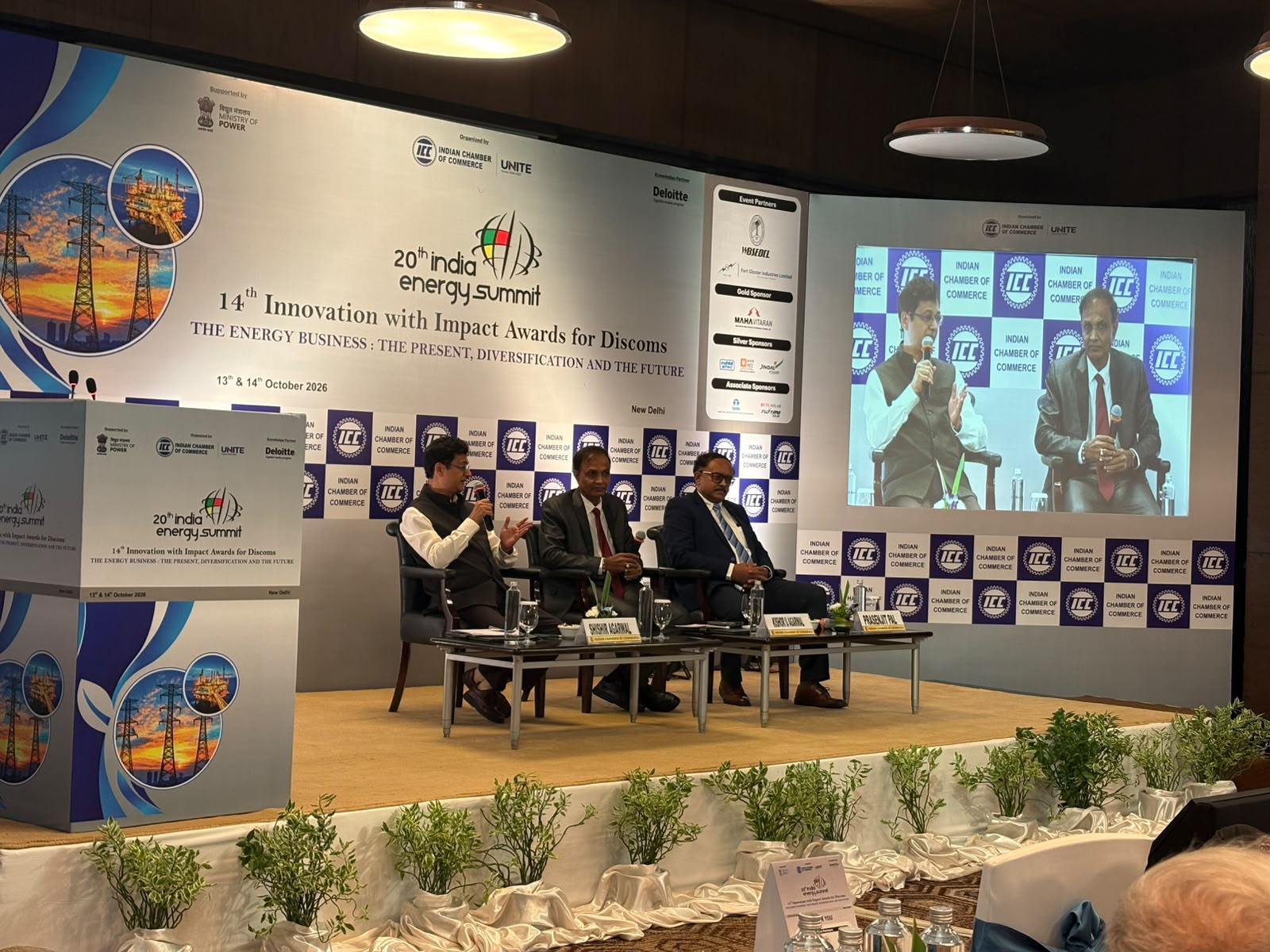
New Delhi, 14 October 2026: Nuclear power moved to the centre of the conversation on the second day of the 20th India Energy Summit organized by the Indian Chamber of Commerce (ICC) summit at Le Meridien, New Delhi.
A focused panel discussion on nuclear power and Bharat Small Reactors (BSRs) examined the opportunities and challenges associated with scaling nuclear energy in India, bringing into focus the need for robust supply chains, technically suitable sites, stronger regulatory capacity and greater collaboration between industry and government.
Industry experts highlight the challenges of scaling nuclear power in India, from site selection and water availability to supply-chain preparedness and regulatory capacity, while outlining a roadmap for the next five years through standardisation, domestic manufacturing and private-sector participation. India’s ambition to expand nuclear power generation will depend as much on strengthening execution capabilities as on advancing reactor technology, emerged as a key takeaway from the second day of the event.
As India looks towards the long-term ambition of expanding its nuclear power capacity from approximately 8.8 GW towards 100 GW, the discussion underscored the importance of translating this vision into a practical implementation framework. While India has developed considerable expertise in reactor design, engineering and operations, scaling capacity will require a coordinated approach to land acquisition, community engagement, water resource management, specialised component manufacturing and skilled manpower.
A central theme of the discussion was the Bharat Small Reactor programme, which seeks to leverage India's established 220 MW pressurised heavy water reactor technology to meet the captive power requirements of industries. With round-the-clock, low-carbon electricity becoming increasingly important for energy-intensive sectors, BSRs offer a potential pathway for industrial decarbonisation, subject to the applicable regulatory framework and implementation arrangements.
Highlighting the evolution of India's nuclear reactor programme, Kishor U Aggarwal emphasised that the country's experience with 220 MW reactors provides a strong engineering foundation for the BSR initiative.
Aggarwal, who spent 36 years at the Nuclear Power Corporation of India Limited (NPCIL) before moving to Vedanta Power, traced how BSR came about. As the world turned its attention to small modular reactors, the Government of India asked how private industry could be brought into nuclear power for its own captive needs, which he put at about 65 to 70 gigawatts today. Industry wanted continuous, carbon-free base load power, and the answer was NPCIL's well-tested 220 MW reactor, which private partners can build jointly with NPCIL while NPCIL operates the plant.
“The 220 MW reactor is a proven technology, with the last unit built by NPCIL commencing commercial operations in 2012. Since then, these reactors have demonstrated reliable performance, with all units continuing to operate and deliver power. The Bharat Small Reactor programme therefore builds on decades of operating experience, while standardisation has helped resolve several engineering challenges. The priority now is to strengthen the domestic supply chain and equip Indian industry to support wider deployment,” he said.
Highlighting the technology’s operational advantages, he noted that one reactor at Kaiga had operated continuously for more than 1,000 days. The reactors also allow refuelling without shutting down operations, ensuring an uninterrupted power supply. Further, a single truckload of fuel can sustain a reactor’s operations for approximately a year, in contrast to the substantial daily coal transportation requirements of conventional coal-fired power plants.
On standardisation, he said the engineering is now settled for developers. “The engineering has been done so well that anybody who comes can go straight to ordering equipment. Whether it is a nuclear system or a secondary system, it is now standardised,” he said, adding that 3D models of the plant are available. Only two niche components, currently imported from Europe and Japan, are not yet made in India, and he expects Indian industry to start supplying them within a year or two.
On supply chain and skills, he said NPCIL is setting up a separate engineering division exclusively for private industry, expected to be in place in three to four months, and has tied up with Engineers India Limited for design inputs.
Prasenjit Pal, Senior Advisor – Nuclear at Bajaj Energy and former Executive Director (Nuclear) at NTPC Parmanu Urja Nigam Ltd. drew on his experience of land, regulatory and community challenges at the Mahi Banswara project in Rajasthan to tell developers what to expect. “Siting a nuclear power project is totally a different cup of tea,” he said. Unlike a textile unit or a conventional power plant, where a large plot with water, power and rail access is often enough, a nuclear site must be geotechnically sound, have a major water source, and sit well away from seismic faults and from major military or industrial establishments.
He explained that a twin 700 MW project needs roughly 15 lakh cubic metres of concrete and about 80 million cubic metres of water a year. Regulations rule out any fault lineament within 5 km of the site and further is better. Seismic zones 1 to 3 are comfortable for construction, zone 4 adds cost, and the Indian 700 MW design is not suited to zone 5 as it stands, though it can be redesigned at a price, as Japan's reactors show. On the east coast, deep sedimentary deposits can push up foundation costs, but suitable sites do exist.
The underlying idea here was that the land must be geotechnically suitable to support substantial reactor foundations, while sites must also meet seismic safety requirements, have access to adequate water resources and comply with prescribed separation distances from critical installations. These considerations significantly narrow the number of locations that can qualify for nuclear development.
He also stressed that nuclear regulation works differently from other power sectors. “In nuclear, the regulator is involved right from the siting stage. At every stage the regulator is involved,” he said, listing in-principal site acceptance, siting clearance, excavation clearance and clearance for the first pour of concrete from the Atomic Energy Regulatory Board. He added that the regulator is meticulous about data, and that submissions must be accurate.
Pal said community trust matters as much as engineering. At Mahi Banswara, where investment of about ₹48,000 crore is planned, new schools, concrete roads, solar streetlights and a medical van scheme gave nearby villages visible proof of the project's benefits, backed by a large team of rehabilitation officers who went door to door. “The local population has to be with you to enable you to establish a project,” he said. He added that excavation is about 50 days ahead of schedule, clearance for the first pour of concrete is expected around the middle of next year, and the first unit is targeted for criticality in 2032. “It is a long haul, but we seem to have made a good start.”
Turning to equipment, Pal noted that outside the reactor, a nuclear plant resembles any steam-based power plant. “Once the steam is outside the reactor, it is just like any other steam-based power plant,” he said, urging that existing thermal power vendors be allowed to participate in the non-nuclear island with suitably adjusted ratings. For the nuclear island, he flagged the need for special alloys that resist neutron-induced brittleness, and for more agencies able to turn them into reactor components that must be guaranteed for the lifetime of the plant.
Where India's nuclear push stands today
The discussion came at a defining moment for the sector. The SHANTI Act, which received Presidential assent on 20 December 2025, replaced the Atomic Energy Act, 1962 and the Civil Liability for Nuclear Damage Act, 2010. It allows private companies to take part in plant operations, power generation and equipment manufacturing, and replaces the single cap on operator liability with a graded framework.
The panel and industry data point to a familiar set of hurdles. Capital costs are high and projects can take 10 to 12 years to build, tying up money long before revenue begins, while developers are still looking for clarity on tariffs, offtake, fuel supply and licensing under the new law. Sites that meet geotechnical, water, seismic and exclusion distance norms are hard to find, and every stage needs regulatory approval. Special alloys for reactor components are largely imported, only a few agencies can convert them into reactor-grade parts, and a couple of niche components are not yet made in India. Building a skilled workforce and winning the trust of local communities complete the list.
Over the next five years, the task is to move from policy to projects. The panel pointed to clear near-term markers: NPCIL's dedicated engineering division for private industry within months, Indian suppliers expected to start making the remaining imported components within a year or two, and, at Mahi Banswara, clearance for the first pour of concrete around the middle of next year and first unit criticality in 2032.
Nationally, reactors now under construction are due to be commissioned progressively by 2031-32, and a 220 MW small reactor is estimated to take 60 to 72 months to build after final approvals. The government also aims to have at least five indigenous small modular reactors operating by 2033, a stepping stone towards 100 GW by 2047.
The day concluded with the ICC Awards, including the Best State Power Utility Awards and the 14th Innovation with Impact Awards for Discoms 2026, recognising consistently performing public- and private-sector power distribution companies from across India. The awardees included Maharashtra State Electricity Distribution Company Limited, Kerala State Electricity Board, BSES Yamuna Power Limited, Northern Power Distribution Company of Telangana Limited, Tata Steel Utilities and Infrastructure Services Limited, and West Bengal State Electricity Distribution Company Limited. The summit was organised by the Indian Chamber of Commerce, with Deloitte serving as Knowledge Partner and Award Evaluator.
Company :-PR Professionals
User :- Ranjit Singh
Email :-ranjit@prprofessionals.in


To ensure stability and reachability of your applications at all times, remote DDoS protection can keep your hosting services online