

Hot Press News
- Department of Drinking Water & Sanitation
- Licious takes the prep out of protein with its new Daily Protein Fix range
- Civita App Introduces Mobile Community Engagement for Local Governments
- Swiggy Dineout Launches ‘Order-in-Cinemas’ to Make Movie-Time Snacking More Convenient; Partners with Cinepolis, Asian Cinemas & PoS Aggregators
- ARM MLM Software Shares Key Insights on Choosing the Right MLM Software in the USA
- Samsung India hosted Kids Day@Samsung 2026 at its Gurugram head office for Kids to Reimagine Technology
- Thalassemia Patients Advocacy Group honours 'Saksham Yodhas' breaking barriers and inspiring change
- Veeba expands its portfolio with Veeba Heritage, enters chutney category
- Roumans Recovery Expands Car Towing Service for Local Drivers
- KidZania India Invites Adults, with or without Kids in Tow, to Rediscover the Joy of Play at 'KidZania Open House'
- Punyam Academy Launches OSHA General Industry 10-Hour Training Online Course
- Gentleman Jack Puts A Regional Spin On The Whiskey Sour With Gentleman Sour Month
- SkillWaala Highlights Social Bookmarking Sites for Better Content Discovery
- Clear Sky Plan Management Launches NDIS Plan Management to Help Participants
- Honda Motorcycle & Scooter India Announces Prices of ADV160 & Rebel 300
 Mail to a Friend Mail to a Friend |
|
 Rate Rate |
 |
Department of Drinking Water & Sanitation
2026-08-25 03:52:01
News & Society
119
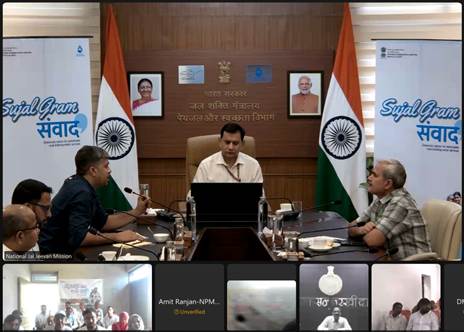
25 August 2026, Delhi: The Department of Drinking Water & Sanitation (DDWS), Ministry of Jal Shakti, organised the 10th edition of the multilingual ‘Sujal Gram Samvad’ today, providing a platform for direct interaction with Gram Panchayat (GP) representatives and local communities on operation and maintenance (O&M) of rural drinking water systems. This reinforces the government’s commitment to community-led water governance under the Jal Jeevan Mission (JJM) 2.0.
The Samvad was chaired by Shri Ashok K.K. Meena, Secretary, DDWS, in the presence of Shri Kamal Kishore Soan, AS&MD, NJJM, along with Senior officers from the department.
In his opening remarks, Secretary, DDWS, Shri Ashok K.K. Meena, emphasised the importance of learning from grassroots experiences, challenges and solutions in rural water supply. He highlighted the efforts being undertaken by Gram Panchayats towards regular water supply, water quality, community awareness, grievance redressal, financial management, source protection and greywater management. Highlighting the importance of community ownership and Jan Bhagidari, he urged Gram Panchayats to take greater responsibility for the operation and maintenance of rural water supply systems.
While referring to the 73rd Constitutional Amendment, he underlined the need for effective devolution of Funds, Functions and Functionaries (3Fs) to Panchayats. Further, he emphasised that active community ownership through Village Water & Sanitation Committees (VWSCs), particularly with participation of women, youth and ex-servicemen, is essential to ensure sustainable and reliable drinking water services under JJM 2.0.
The 10th edition of Samvad featured grassroots interactions across 4 Gram Panchayat headquartered villages. The virtual Samvad witnessed a diverse range of participants including Gram Panchayat representatives, members of VWSCs, community participants, Jal Sahiyas, Jal Bahinis, Jal Sakhis, Anganwadi workers, students, teachers, and frontline functionaries from the GPs, along with JJM State Mission Directors, District Collectors/District Magistrates/Deputy Commissioners, DWSM officials, and senior officers from the States. The multilingual Samvad focused on key aspects of sustainable rural water service delivery, including uninterrupted operation of water supply schemes, skilling of local operators, water quality and disinfection, community participation in O&M, financial sustainability through user charges and convergence, grievance redressal, prevention of leakages and misuse, protection of drinking water sources, and the wider impact of reliable drinking water services on health, education, women’s empowerment and local livelihoods.
Voices from the Gram Panchayats
GP: Vasnoli-Dhanagarwada, District: Kolhapur, Maharashtra
During the interaction with village representatives of Vasnoli-Dhanagarwada in Marathi, the villagers shared that the Gram Panchayat has showcased active local participation in water system maintenance.
District official highlighted the challenges faced by remote and tribal communities in Maharashtra in accessing water from springs, including difficulties arising from forest and wildlife-related constraints. Despite these challenges, the district is gradually addressing water-related issues through locally adapted solutions. Automated timers have been installed to regulate water flow, eliminating the need for villagers to enter deep forest areas. The initiative has achieved 100% household tap water connections and zero electricity bills, delivering significant benefits to the community.
Appreciating the initiative, Shri Ashok K. K. Meena, emphasised the need for smaller, locally managed water supply schemes for remote tribal communities and suggested intake of funding support under PM-JANMAN and Dharti Aaba schemes.
GP: Choupra, District: Panna, Madhya Pradesh
During the interaction with DDWS official, the village representatives shared that with the implementation of the Jal Jeevan Mission, households are receiving clean drinking water in the village. They highlighted that the Gram Panchayat has trained technical operators and women trained to use Field Test Kits (FTKs), who undertake timely water quality testing to ensure the safety and reliability of drinking water supplied to households. GP also collects a monthly user charge of ₹100 per household.
District and State officials highlighted that geotagging has been completed under the Sujalam Bharat initiative, while real-time feedback on water services is being collected. The Panchayat Darpan dashboard enables transparent, real-time monitoring of water user-charge collections and provides category-wise information on the performance and participation of GP, Zilla Panchayats and Janpads in water-related activities across the district.
GP: Naanmau, District: Barabanki, Uttar Pradesh
During the interaction with village representatives in Hindi, the villagers shared that household tap water connections under the Jal Jeevan Mission have significantly improved access to safe drinking water. While interaction with a school student it was noted that reliable water availability has ensured regular and adequate access to water within the school premises. The village representative further highlighted that Gram Sabha meetings are conducted, promoting responsible water use, water conservation and community participation for the long-term sustainability of the scheme. A user charge of ₹50 per household per month is collected to support the rural water framework of the village, promoting Jan Bhagidari.
District and State officials highlighted that regular DWSM meetings are conducted, pre- and post-monsoon assessments are undertaken to monitor water resources. In Barabanki, the Jal Sarthi App is being used to disseminate groundwater-level information. Surface water schemes are also being developed, with water distribution from these sources targeted to commence by 2027.
GP: Todi, District: Charkhi Dadri, Haryana
During the interaction with village representatives of GP Todi in Haryanvi, the villagers shared that the Gram Panchayat has developed a strong community-led O&M model for the village water supply system. A monthly user charge (₹40 for General and ₹20 for SC/BC households) is collected and utilised for pipeline maintenance and repair of leakages. The villagers highlighted their active role in community ownership and maintenance, with locally appointed pump operators and plumbers ensuring timely rectification of leakages and other faults.
State officials informed that, with Haryana already declared Har Ghar Jal, the State is continuing its efforts to ensure proper maintenance and sustainability of rural water supply systems.
AS & MD, NJJM, Shri Kamal Kishore Soan, expressed appreciation to the active support of District Collectors and Gram Panchayats for their commitment towards JJM.
While interacting with the District and State officials, he emphasised the need for sensitisation of Gram Panchayats, including proper orientation of operators and panchayat functionaries on valve-operation protocols to ensure equitable water supply to all habitations.
He further emphasised on use of the Decision Support System (DSS) for evidence-based planning and monitoring of water resources, particularly for assessing groundwater conditions and prioritising source sustainability and water conservation measures. Stressing on source sustainability, he called upon all stakeholders to undertake sustained efforts for protecting and rejuvenating drinking water sources so that future generations continue to receive uninterrupted piped water supply.




To ensure stability and reachability of your applications at all times, remote DDoS protection can keep your hosting services online