

Hot Press News
- KLH Aziznagar Brings Global Experts Together to Explore AI and Industrial IoT Security
- ReadyBid Highlights Hotel Booking-Window Intelligence as Corporate Travel Teams Align Negotiations with When Employees Actually Reserve Rooms
- Alko Cabinetry Expands Custom Outdoor Living Solutions for Florida Homeowners
- Agrizy, the Technology-Led CRDMO, building the Backend for 300+ Global Food, Beverage and Wellness Brands across 25 countries
- JBL India and RepIndia travel across India to capture the sounds of celebration with 'Sounds Festive'
- Lumina Laundry Opens New Franchise Store in Sector 62, Noida, expand Its Garment Care Network Across India
- NIIMS Hospital Organises Awareness Programme on Eczema
- Naresh Kumar Kumawat’s Sculptures Add Cultural Significance to Lucknow’s Rashtra Prerna Sthal
- Manipal Hospital EM Bypass Launches Manipal Skull Base Institute for Advanced Care in Complex Skull Base Surgeries
- iCallify Announces Advanced Auto Dialer Software to Automate Outbound Calling and Improve Agent Productivity
- Infomerics Raises Credit Rating of Renny Strips Limited to IVR A- / Stable
- Cura Launches #SharirBoltaHai on Ayurveda Day
- KWT Spider 3.0 Brings AI Search Readiness Into Technical SEO Audits
- Therapists Of NY Expands Access to Specialized Mental Health Support Across New York
- ReNew and Anakapalli District Administration Join Hands to Skill 300 Women for Clean Energy Jobs
 Mail to a Friend Mail to a Friend |
|
 Rate Rate |
 |
Essential AI Tools That CIOs Must Use in 2026
2026-09-24 10:24:23
Technology
1353
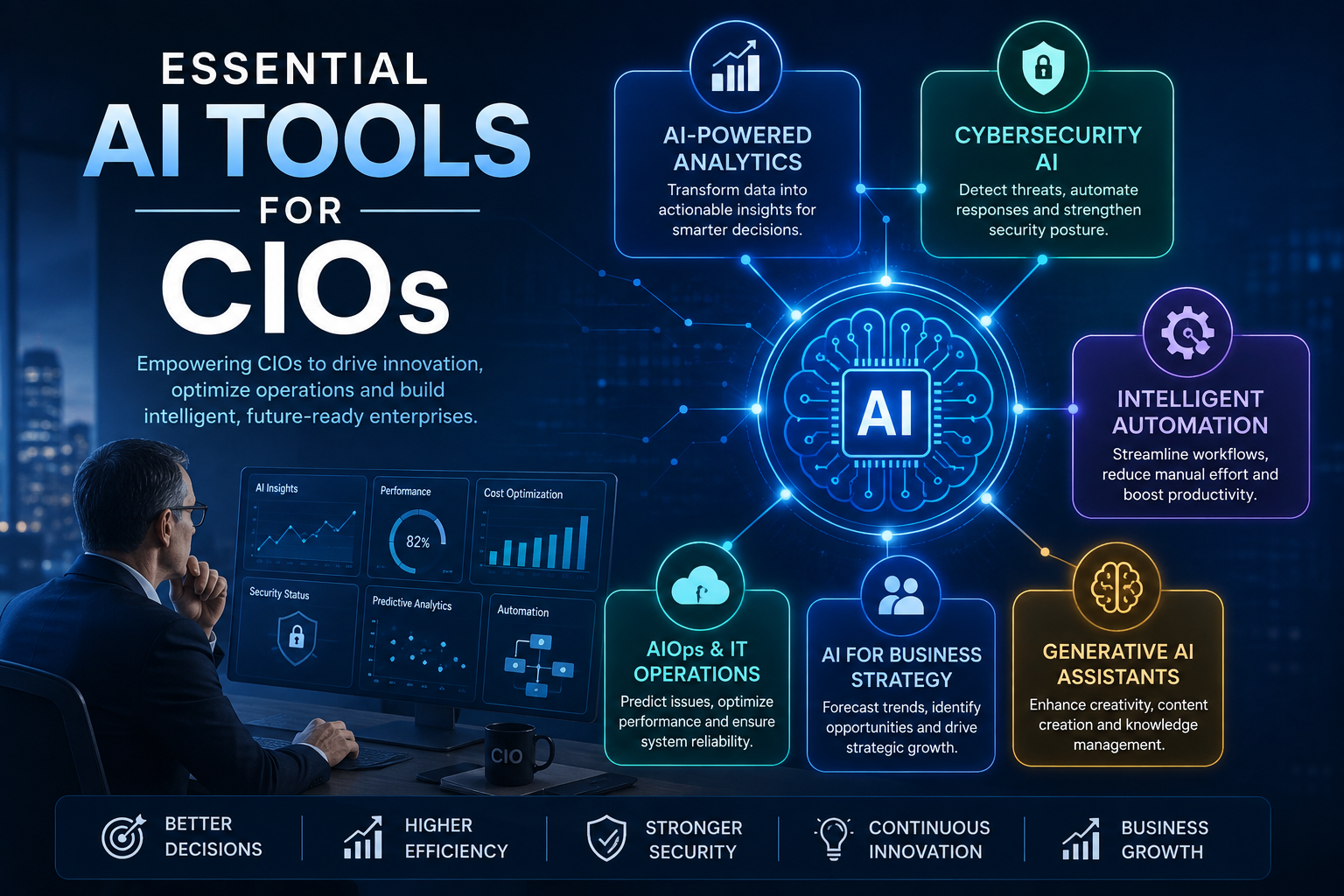
By 2026, artificial intelligence has moved beyond experimentation and entered the core of enterprise technology strategy. For CIOs, the priority is no longer simply adopting AI, but building a secure, governed and measurable AI ecosystem that improves productivity, strengthens cybersecurity, modernizes IT operations and creates new business value.
The enterprise AI landscape is changing rapidly. Generative AI assistants are becoming workplace tools, AI coding platforms are changing software development, autonomous agents are beginning to execute multi-step workflows, and AI governance is becoming an essential component of corporate technology management.
Research published in July 2026 on AI adoption among S&P 500 companies found that 11% of enterprises had AI deeply integrated into business processes in 2025, while another 10% were using AI in production or service delivery. The research also found that deep enterprise AI adoption had more than quadrupled since 2022.
For CIOs, this means that AI should now be viewed as part of the enterprise operating model rather than as another software category.
1. Enterprise AI Assistants and Copilots
The first AI capability CIOs should establish is a secure enterprise AI assistant.
Tools such as ChatGPT Enterprise, Microsoft 365 Copilot and Gemini Enterprise can help employees perform tasks including document analysis, research, summarization, content creation, data analysis, meeting preparation and knowledge discovery.
ChatGPT Enterprise provides organizations with centralized administration, enterprise security and privacy controls, along with capabilities such as data analysis, deep research, file analysis, applications and customizable workflows.
The important CIO consideration is not simply which chatbot produces the best answer. It is whether the platform can be integrated into the organization's identity, security, data and compliance architecture.
CIO Checklist
- Enterprise identity and access management
- Data-loss prevention
- Audit and administrative controls
- Integration with corporate applications
- Data residency and privacy requirements
- Usage monitoring
- AI literacy and employee training
2. AI Agents and Agentic AI Platforms
One of the defining developments of 2026 is the transition from AI that answers questions to AI that can take actions.
AI agents can reason through a task, use enterprise applications, retrieve information, interact with APIs and execute multiple steps with limited human intervention.
Google Cloud introduced its Gemini Enterprise Agent Platform in 2026 with capabilities for building, deploying, scaling, governing and optimizing autonomous AI agents. Google describes the platform as addressing the infrastructure, security and governance requirements involved in moving agents into production.
This represents a major opportunity for CIOs.
An agent could potentially:
- Resolve routine IT tickets
- Prepare management reports
- Analyze procurement requests
- Assist customer-service teams
- Monitor infrastructure
- Perform software-development tasks
- Search corporate knowledge
- Coordinate multi-step business processes
However, autonomy must be matched by governance.
Gartner warns that applying the same governance model to every AI agent can itself create problems. It predicts that by 2027, 40% of enterprises will demote or decommission autonomous AI agents because of governance failures.
Therefore, CIOs should establish different permission levels based on an agent's autonomy, data access and business impact.
3. AI Coding and Software Development Tools
AI-assisted software development has become one of the most immediately useful enterprise applications of AI.
Platforms such as GitHub Copilot can assist developers with code generation, code explanation, testing, debugging, documentation and code review.
GitHub's enterprise offering provides administrative controls, policy management and organizational customization. GitHub also supports enterprise policies governing the availability of models, features and MCP servers.
For CIOs, the business case goes beyond making developers write code faster.
AI coding tools can help organizations:
- Modernize legacy applications
- Accelerate application development
- Automate repetitive programming tasks
- Improve documentation
- Support testing and code review
- Identify and remediate vulnerabilities
- Increase developer productivity
The CIO should nevertheless establish policies governing what source code can be exposed to AI systems and how generated code is reviewed before entering production.
4. AI Cybersecurity Tools
AI is becoming both a cybersecurity capability and a cybersecurity threat.
Attackers can use AI to automate phishing, social engineering, vulnerability discovery and other malicious activities. At the same time, defenders can use AI to analyze massive quantities of security telemetry and identify suspicious patterns.
Consequently, CIOs should prioritize AI-enabled cybersecurity capabilities across:
- Security operations
- Endpoint protection
- Identity security
- Threat detection
- Vulnerability management
- Security analytics
- Incident response
- Fraud detection
The emergence of AI agents creates another security challenge: non-human identities.
An autonomous agent may have credentials, API access and permission to interact with enterprise systems. CIOs therefore need to know not only which employees have access to corporate systems, but also which AI agents have access, what they can do and who is responsible for their actions.
5. AI Governance and Risk Management Platforms
AI governance is no longer optional for large organizations.
CIOs should maintain an inventory of AI models, applications and agents and establish policies governing their use.
A useful foundation is the NIST AI Risk Management Framework (AI RMF). NIST's Generative AI Profile provides organizations with guidance for identifying and managing risks associated with generative AI. In April 2026, NIST also released a concept note for a Trustworthy AI Profile focused on critical infrastructure.
An enterprise AI governance platform should ideally provide:
- AI system inventories
- Risk classification
- Model evaluation
- Data lineage
- Access controls
- Audit trails
- Policy enforcement
- Performance monitoring
- Incident management
This is particularly important as organizations move from individual AI applications to fleets of interconnected agents.
Gartner estimates that the average Fortune 500 company could have more than 150,000 AI agents by 2028, compared with fewer than 15 in 2025. Gartner also reported that only 13% of organizations believe they currently have the right AI-agent governance in place.
For CIOs, this highlights the importance of building governance before agent proliferation becomes unmanageable.
6. AI-Powered Enterprise Search and Knowledge Management
Corporate information is often distributed across email, intranets, SharePoint repositories, CRM systems, ERP platforms document-management systems and cloud storage.
Traditional search systems struggle to understand context across these sources.
AI-powered enterprise search can provide a natural-language interface through which employees ask questions and receive answers based on authorized corporate information.
For example:
"What were the reasons for the increase in customer complaints during the last quarter?"
An AI knowledge system could potentially analyze information across customer-service records, reports, emails and operational documents, subject to the user's permissions.
This can reduce information-search time and make organizational knowledge more accessible.
However, CIOs must ensure that AI search does not accidentally expose information that users are not authorized to access.
7. AI-Powered Data Analytics and Business Intelligence
The traditional business intelligence model requires users to understand dashboards, databases and predefined reports.
AI is changing this model by allowing business users to interact with data using natural language.
CIOs should evaluate AI analytics tools capable of:
- Natural-language queries
- Automated data analysis
- Anomaly detection
- Predictive analytics
- Forecasting
- Automated reporting
- Scenario analysis
- Executive dashboards
The real value comes when AI analytics moves from simply describing what happened to helping executives understand why it happened and what could happen next.
For example, instead of asking:
"What were our sales last quarter?"
an executive might ask:
"Why did sales decline in Region A, and which factors are most likely to affect sales during the next quarter?"
That represents a major shift in how executives interact with corporate data.
8. AIOps and AI-Powered IT Operations
Enterprise IT infrastructure has become too complex for traditional monitoring alone.
Cloud environments, containers, APIs, SaaS platforms, distributed applications and hybrid infrastructure produce enormous quantities of telemetry.
AI-powered AIOps tools can analyze this information to identify:
- Abnormal behavior
- Potential outages
- Performance problems
- Root causes
- Capacity requirements
- Infrastructure inefficiencies
The next generation of AIOps will increasingly combine observability with AI agents capable of recommending or executing remediation.
For CIOs, the goal should be a transition from reactive IT operations to predictive and increasingly autonomous IT operations.
9. AI-Powered IT Service Management
The IT help desk is another area where AI can produce immediate benefits.
AI can automatically classify support tickets, summarize incidents, search knowledge bases and provide employees with conversational self-service.
More advanced systems can potentially execute approved remediation actions automatically.
For example, an employee might report:
"I can't access the corporate VPN."
Instead of simply creating a ticket, an AI-powered IT service system could identify the user's device, check authentication status,
review recent incidents and guide the user through an approved resolution process.
Human intervention should remain available for complex or high-risk incidents.
10. AI Infrastructure and Cloud Cost Optimization
AI workloads can be computationally expensive, particularly when organizations deploy large models, AI agents and high-volume inference applications.
CIOs therefore need AI-enabled tools for monitoring infrastructure and controlling costs.
These tools should help answer questions such as:
- Which AI workloads consume the most resources?
- Which models provide the best cost-to-performance ratio?
- Where are cloud resources underutilized?
- Which workloads should run on-premises versus in the cloud?
- How much does each AI application cost per transaction?
- What is the ROI of each AI deployment?
The emergence of AI makes FinOps and AI governance increasingly interconnected.
A CIO should be able to see not just total cloud expenditure, but the business value being generated by each significant AI workload.
11. AI-Powered Customer Experience Tools
AI should not remain confined to the IT department.
CIOs should work with business leaders to deploy AI across customer-facing operations.
Potential applications include:
- Conversational customer support
- Voice assistants
- Customer sentiment analysis
- Personalized recommendations
- Automated service workflows
- Customer journey analysis
- Intelligent CRM assistance
The CIO's responsibility is to ensure that these systems integrate securely with CRM, ERP and other enterprise systems while maintaining appropriate privacy controls.
12. AI Compliance, Privacy and Data Protection Tools
As AI systems gain access to corporate data, data governance becomes inseparable from AI strategy.
CIOs should consider tools and controls that can identify sensitive information and enforce policies around how that information is
accessed, processed and shared.
Important data categories include:
- Personally identifiable information
- Financial information
- Customer records
- Intellectual property
- Confidential business information
- Employee information
- Regulated data
Regulatory developments make this particularly important. In the European Union, the majority of the EU AI Act's rules entered into application on 2 August 2026, with enforcement beginning for applicable provisions.
Even organizations outside the EU may need to consider AI regulatory requirements when serving European customers on operating across jurisdictions.
The Five Questions Every CIO Should Ask Before Buying an AI Tool
The biggest mistake CIOs can make in 2026 is treating AI as a technology-shopping exercise.
1. What business problem does it solve?
AI should address a measurable business or operational problem rather than being deployed simply because it is technologically impressive.
2. What measurable value will it generate?
Possible metrics include productivity, revenue, cost reduction, service quality, employee experience, security improvement and time saved.
3. What data does it access?
CIOs should understand precisely what information an AI system can access, process, store and transmit.
4. What happens when the AI makes a mistake?
Organizations need clear escalation mechanisms, human oversight and rollback procedures—particularly when AI agents can take actions independently.
5. How will the system be governed?
Every enterprise AI system should have an identifiable owner, defined permissions, monitoring, security controls and an appropriate risk classification.
From AI Adoption to AI Operating Models
The most important shift for CIOs in 2026 is that AI strategy can no longer be separated from enterprise strategy.
The organizations that gain the greatest value from AI are unlikely to be those that simply deploy the largest number of AI applications. They will be organizations that redesign processes around the collaboration of people, software and AI agents.
Google Cloud describes this emerging model as the "agentic enterprise," where AI agents and human experts collaborate within redesigned business operations.
At the same time, Gartner's research highlights the risk of fragmented agent deployments and inadequate governance.
This puts CIOs at the center of a new responsibility: creating an AI ecosystem that is simultaneouslyproductive, secure, governed, interoperable and economically sustainable.
Conclusion
AI tools have become essential components of the modern CIO's technology portfolio.
Enterprise AI assistants can improve employee productivity. AI coding tools can accelerate software development. AIOps can make IT operations more predictive. AI cybersecurity can strengthen threat detection. Enterprise search can unlock organizational knowledge. AI analytics can improve decision-making. And agentic AI can fundamentally change how business processes are executed.
But technology alone will not create enterprise value.
The CIO's competitive advantage in 2026 will come from combining AI capabilities withstrong governance, secure data architecture, measurable ROI, responsible automation and organizational change.
The central question is therefore no longer:
"Which AI tool should we buy?"
It is:
"Where can AI create the greatest measurable business value—and how can we deploy it securely,
responsibly and at enterprise scale?"
That is the question that should define the CIO's AI agenda for 2026 and beyond.
References and Further Reading
- NIST — AI Risk Management Framework
NIST's framework provides a foundation for managing AI risks across the AI lifecycle.
NIST AI Risk Management Framework - Gartner — AI Agent Governance
Gartner's 2026 research examines governance challenges associated with autonomous AI agents.
Gartner: AI Agent Governance - Gartner — Managing AI Agent Sprawl
Research addressing the growing challenge of managing large numbers of enterprise AI agents.
Gartner: Managing AI Agent Sprawl - OpenAI — ChatGPT Enterprise
Information on enterprise administration, privacy, security and AI capabilities.
ChatGPT Enterprise - GitHub — Copilot for Enterprise
Information on enterprise AI-assisted software development, policies and governance.
GitHub Copilot - Google Cloud — Gemini Enterprise Agent Platform
Information on building, deploying, scaling and governing enterprise AI agents.
Gemini Enterprise Agent Platform - European Commission — EU AI Act Implementation Timeline
Current implementation milestones and applicable requirements under the EU AI Act.
EU AI Act Implementation Timeline

Get your Explainer Video at 100 dollars only Today.


To ensure stability and reachability of your applications at all times, remote DDoS protection can keep your hosting services online