

Hot Press News
- KLH Aziznagar Marks New Milestones in Technology and Innovation
- FILM & TAPE EXPO 2026 Concludes in Shenzhen, Connecting Global Functional Film and Adhesive Tape Industries
- Mathapathi Celebrates 25 Years of Building Homes and Shaping Residential Communities in Bengaluru
- TOTO India Introduces GN and GK Faucet Series, Bringing Japanese Design Heritage to Contemporary Bathrooms
- Civita 311 Brings Free Citizen Engagement Services to Small U.S. Communities
- Vikas Kumbh 2026 to Bring India’s Development Story to Centre Stage at Bharat Mandapam on December 10, 2026
- BADR AL SAMAA Strengthens Cardiac Healthcare Services with Comprehensive Heart Care in Muscat
- Aaron Marjala Develops New Perspectives on Property Risks and Assessments
- My Smile For Life Highlights Emergency Dental Care and Affordable Root Canal Options in Philadelphia
- Rush Turkey Electronic Visa Service: How to Get Your Turkey eVisa Faster
- Tally Prime Software in Bangalore
- Arna Softech Expands AI Engineering for Business Growth
- Manipal Hospital Dhakuria Highlights the Possibility of Treatment of Vesicovaginal Fistula Through Minimally Invasive Surgery
- The Bakery LLC Continues to Bring Sweet Experiences and Fresh Bakery Delights to Dubai
- ReadyBid Highlights Cybersecurity Response Teams as a New Priority for Corporate Hotel Sourcing in 2027
 Mail to a Friend |
|
 Rate |
 |
Wearable Facial Sensors Help Patients with Amyotrophic Lateral Sclerosis (ALS) Communicate
2026-11-23 08:54:41
Technology
281
Researchers have designed a skin-like device that attaches to the face and measures small movements like a twitch or a smile. In this way, patients with Amyotrophic Lateral Sclerosis (ALS) can communicate a variety of emotions through small movements that can be measured and interpreted by the device. People with Amyotrophic Lateral Sclerosis (ALS) have a gradual decrease in their ability to control their muscles. As a result, they often lose their ability to speak and have difficulty communicating with others.
A research team at the Massachusetts Institute of Technology has now designed a retractable, skin-like device that can be attached to a patient's face and can measure small movements such as twitching or smiling. The study was published in Nature Biomedical Engineering.
The researchers hope their new device will allow patients to communicate more naturally without having to deal with bulky equipment. The wearable sensor is thin and can be camouflaged with makeup to match any skin tone, making it unobtrusive.
"Our device is not only malleable, flexible, disposable and portable, but it is also visually invisible," said Canan Dagdeviren, LG Electronics Assistant Professor of Career Development at MIT Media Arts and Sciences and leader of the research team.
"You can fake it and no one will think you have anything on your skin. The researchers tested their initial version of the device on two ALS patients (one female and one male, gender-balanced) and showed that it could accurately distinguish between three different facial expressions - the smile, the open mouth and the pout.
Modeling Device Behavior During Facial Deformation
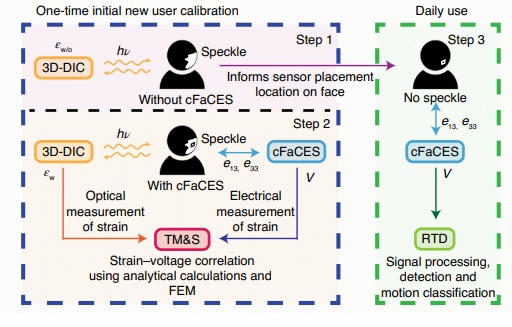
Since piezoelectric elements convert mechanical energy into electrical energy, the experimental voltage observed in the 3D-DIC test can be used to predict the strain expected from DIC measurements of deformation on the top surface of the sensor applied to the skin.
A contour map based on skin tension, without overlaying CFACES on the skin, helps guide the placement of CFACES onto the facial skin so that the strain observed by the four sensing elements is temporarily different for different movements. The position of the sensor can be qualitatively selected by superimposing the contour plot of similar motion observed at the peak strain. The orange squares represent the potential positions of the four sensing elements, which will result in different strain observations on each element.
As we know, Hawking died in 2018 from the slow-moving amyotrophic lateral sclerosis disease. He was able to communicate through an infrared sensor that detected the twitch of his cheek as he moved the cursor across rows of letters. While effective, the process can be time-consuming and requires a lot of equipment.
The Integrable Decoding Group is DagDeviren's laboratory that specializes in the development of integrable (flexible and stretchable) electronic devices that can be attached to the human body for a variety of medical applications. She became interested in ways to help people with neuromuscular diseases communicate after meeting Stephen Hawking in 2016. Hawking was visiting Harvard University, where Dagdeviren was a young member of the Society of Researchers. The device they built is made up of four piezoelectric sensors, all of which can be easily mass-produced, so the researchers estimate the cost of each device to be about $10.
"We had people do different movements, and then we created a strain map of each part of the face." "We then look at our strain diagram to determine the correct strain level that we see on the face of our equipment and determine that this is the right place to place the equipment for testing." The researchers also used measurements of skin deformity to train machine learning algorithms to distinguish between the smiling, open mouth and pouting.
Using the algorithm, they tested the device on two ALS patients and were about 75 percent accurate in distinguishing between these different movements. In healthy subjects, the accuracy rate was 87 percent.
Based on these detectable facial movements, a library of phrases or words can be created to correspond to different combinations of movements. "We can create customizable information based on your actions," DagDeviren said. Technically, you can create thousands and thousands of messages, and no other technology can do that right now. It all depends on your library configuration, which can be designed for a particular patient or group of patients."
The researchers have patented the technique and they now plan to test it on other patients. In addition to helping patients communicate, the device could also be used to track patients' progress or measure whether the treatment they are receiving is working, researchers say.
Company :-Apogeeweb
User :- Rachel Ye
Email :-fadjdagd@gmail.com
Url :- https://www.apogeeweb.net/electron/what-is-a-proximity-sensor.html
 1_thumb.png)

Get your Explainer Video at 100 dollars only Today.
To ensure stability and reachability of your applications at all times, remote DDoS protection can keep your hosting services online